Grimsby has undergone one of Britain's most remarkable industrial transformations, swapping its identity as the world's largest fishing port for a new role at the centre of the offshore wind revolution.
The Cod to Turbines Shift
In the 1950s, Grimsby claimed the title of the world's largest fishing port. By 1970, approximately 400 trawlers called the harbour home, and the industry employed thousands across the town. The port's decline began with the Cod Wars of the 1970s and accelerated under the European Union's Common Fisheries Policy. By 2013, the once-mighty fleet had dwindled to just five trawlers.
The same year revealed the shape of things to come: whilst five fishing vessels remained, 15 vessels were already operating from Grimsby to service offshore wind farms in the North Sea. The port that had landed one-tenth of all fish consumed in Britain by 1900 was pivoting towards a new maritime industry.
The Offshore Wind Arrival
The transformation gained momentum in 2013 when DONG Energy, now Ørsted, selected Grimsby's Royal Dock as its operations and maintenance base for the Westermost Rough Wind Farm. The Danish company, which has developed approximately 30 per cent of global offshore wind capacity excluding China, established a permanent presence that would expand across subsequent years.
Associated British Ports, which operates 21 ports across the UK and handles roughly 25 per cent of Britain's sea-borne trade, invested in upgrading the Royal Dock infrastructure. In 2014, contractor Ravestein replaced the lock gates, enabling 24-hour vessel operations for the first time. This infrastructure investment proved critical to Grimsby's emergence as a servicing hub.
Supporting the World's Largest Wind Farms
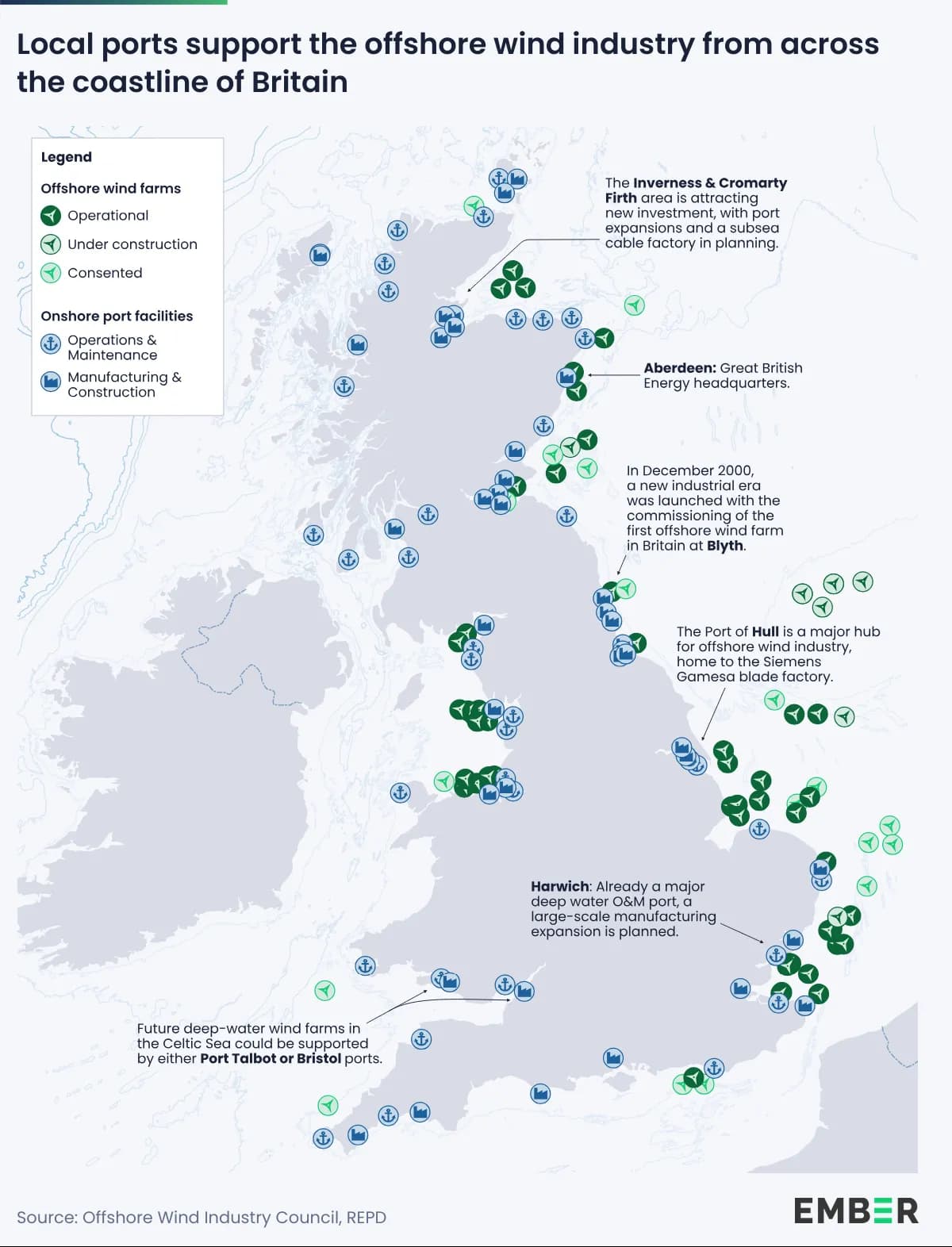
Grimsby's strategic position has made it the operational hub for some of the world's largest offshore wind developments. The Hornsea Wind Farm, located approximately 120 kilometres off the Yorkshire coast, represents a massive undertaking: Hornsea One, operational since December 2019, generates 1,218 megawatts from 174 turbines; Hornsea Two, which began operations in August 2022, produces 1,386 megawatts from 165 turbines and was the world's largest offshore wind farm at launch; Hornsea Three, with a capacity of 2.9 gigawatts, received consent in December 2020.
The Dogger Bank Wind Farm, situated between 130 and 200 kilometres offshore, represents an even larger project. With a total expected capacity of 8.1 gigawatts, it is the world's largest offshore wind farm currently under construction. The development comprises three phases: Dogger Bank A and B, each generating 1,235 megawatts using 95 GE Haliade-X 13-megawatt turbines; Dogger Bank C, producing 1,218 megawatts from 87 turbines. The nearby Sofia wind farm, operated by RWE, adds a further 1,400 megawatts using 100 Siemens Gamesa 14-megawatt turbines.
In October 2023, Dogger Bank began producing electricity. Prime Minister Rishi Sunak stated at the time: "Offshore wind is critical to generating renewable, efficient energy that can power British homes from British seas." Each rotation of the wind farm's 107-metre blades can power an average British home for two days; once fully operational, the project is expected to generate 3.6 gigawatts, sufficient for six million UK homes.
The Companies Behind the Transition
Several major energy companies now operate from Grimsby. Ørsted, the world's largest offshore wind developer, maintains its operations and maintenance centre at the Royal Dock and operates Hornsea One, Two, and Three alongside Westermost Rough. SSE Renewables, in joint venture with Equinor, is developing Dogger Bank A, B, and C. RWE operates the Sofia wind farm. Green Investment Group and Marubeni Corporation hold stakes in Westermost Rough.
Local Economic Impact
The offshore wind sector has brought significant investment to the Humber region. Associated British Ports announced job creation following a £300 million finance deal. The sector employs around 40,000 people across the UK, with 7,000 jobs added in the two years to 2025. Common roles include turbine technicians, high-voltage technicians, and supporting positions in legal and finance functions.
Alistair Phillips-Davies, chief executive of SSE, has described Dogger Bank as providing "a significant boost to UK energy security, affordability and leadership in tackling climate change."
The Bigger Picture
Britain became the world leader in offshore wind capacity in October 2008, overtaking Denmark. The government has set a target of 50 gigawatts of offshore wind capacity by 2030. Total UK offshore wind capacity reached 11.3 gigawatts by the start of 2022, meaning substantial further expansion is required to meet the 2030 goal.
For Grimsby, the transition represents more than economic substitution. The port that once landed fish from Icelandic waters, with 13,000 tonnes of the 18,000 tonnes sold at Grimsby fish market in 2012 arriving from Iceland, has found a new purpose in an industry aligned with Britain's net zero ambitions. The vessels that once hunted cod now service turbines, and the dockworkers who once handled fish now manage the logistics of renewable energy infrastructure.