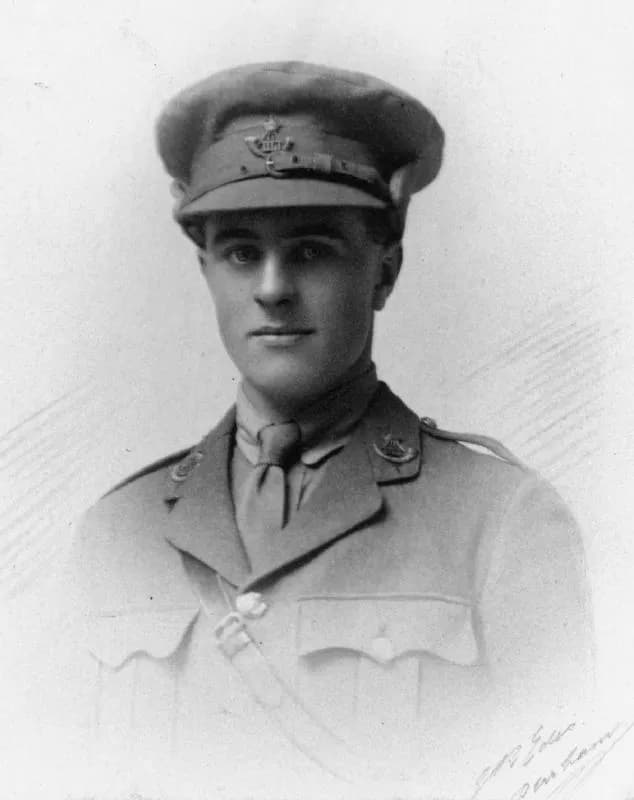
The 10th (Service) Battalion of the Lincolnshire Regiment remains the only one of Kitchener's 304 'Pals Battalions' to bear a different name. They called themselves the Grimsby Chums.
From Schoolyard to Barracks
On 9 September 1914, a telegram arrived at Grimsby Town Hall. Alderman John Herbert Tate, the Mayor, received orders from the War Office to raise a battalion for Kitchener's New Army. The initial recruits came not from factories or football clubs, but from the assembly halls of Wintringham Grammar School. Two hundred and fifty former pupils formed the core of the new unit, mustering at the school's Officer Training Corps armoury.
The battalion completed its recruitment on 8 November 1914. Men arrived from across the region: Grimsby, Boston, Louth, and Scunthorpe. A contingent of 150 men from Wakefield, Yorkshire, joined when the unit trained at Ripon. The town council oversaw the entire effort, transforming a schoolboy initiative into a full military battalion.
Why 'Chums'?
Every other Pals Battalion in Britain adopted the word 'Pals' in their title. The Grimsby unit alone chose 'Chums'. The name reflected the Wintringham School origin; these were former classmates, friends who had sat together in classrooms, now enlisting together. The term captured a different quality of relationship than the workplace camaraderie that defined most other units.
Military Service and Command
The unit received its official designation as the 10th (Service) Battalion, Lincolnshire Regiment. Initial command fell to George Bennet, a local merchant and retired Captain of the 1st Lincolnshire Royal Garrison Artillery Volunteers. Permanent command eventually passed to George Heanage, appointed more for his local standing than military experience. Other officers included local men Captain T. Maudsley and Lieutenant W. Vignoles.
The battalion moved through a series of training camps: Brocklesby Camp on the Earl of Yarborough's estate from 5 December 1914, then Studley Royal Camp at Ripon from June 1915, followed by Strensall and Salisbury Plain. They landed at Le Havre, France, in January 1916.
The Somme: 1 July 1916
The Grimsby Chums' defining action came on the first day of the Battle of the Somme. They formed part of the first wave attacking La Boisselle village, positioned to advance immediately after the detonation of the Lochnagar mine at 7.28 am. Zero hour was set for 7.30 am.
The attack proved catastrophic. Of the battalion engaged that morning, only Second Lieutenant Harold P. Hendin reached the German reserve trenches, leading five men. The battalion suffered 502 casualties on that single day: 15 officers and 487 other ranks. Only two officers returned unwounded. Approximately 100 men survived the assault unscathed.
Later Service and Casualties
The battalion fought on through the remainder of the war. They saw action at Arras in April 1917, where they suffered further heavy losses: 420 casualties at the Rouex Chemical Works on 28 April alone. They served at Passchendaele in October 1917 and endured the German Spring Offensive of 1918.
By 18 May 1918, the battalion had been reduced to cadre strength after sustaining such heavy losses. They transferred between several brigades during 1918, finally serving with the 197th Brigade, 66th Division. The War Office formally disbanded the unit on 3 June 1919.
Memorials in Grimsby
Grimsby Minster (formerly St James' Church) houses the battalion's principal memorial. A stone tablet commemorates the 810 members of the 10th Battalion who died on service. Canon Algernon Markham led the initiative to complete a Memorial Chapel in 1921. On 6 July 1919, the battalion's Colours were formally handed to the church.
The Minster also holds a Roll of Honour listing 2,100 local people who died in the First World War, inscribed on gunmetal donated by Sir Alec Black. Two additional memorials to the 34th Division, of which the Grimsby Chums formed part, stand at La Boisselle and Mont Noir near Armentieres, unveiled in 1923.
What Is Confirmed
The formation date (9 September 1914), official designation as 10th (Service) Battalion Lincolnshire Regiment, the Wintringham School origins, the Somme casualties (502 on 1 July 1916), and the memorial details at Grimsby Minster are all documented in military records and local archives.
What Is Unclear
The precise origin of the decision to use 'Chums' rather than 'Pals' is attributed to the school connection, but the specific individual or meeting that made this choice is not recorded in available sources.