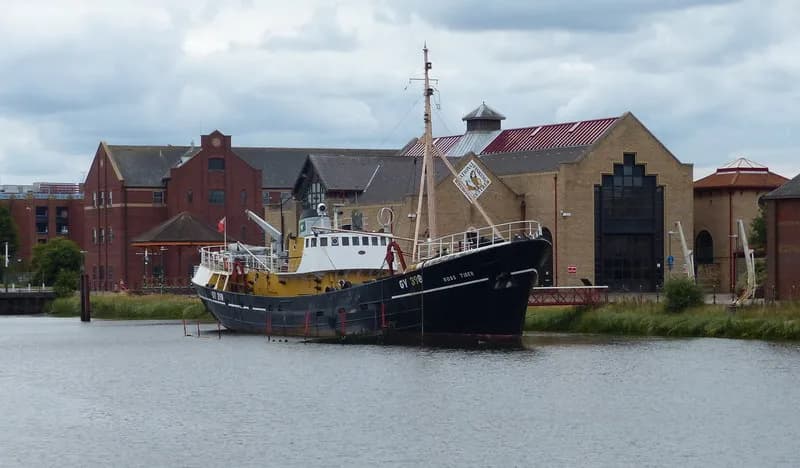
The Ross Tiger remains the sole surviving vessel of the fleet that once made Grimsby the world's largest fishing port. Built in 1957, this sidewinder trawler now serves as the centrepiece of the National Fishing Heritage Centre at Alexandra Dock.
The Cat Class and a Golden Era
Ross Tiger (GY398) was the first of twelve "Cat Class" middle-water trawlers constructed for Ross Trawlers Ltd between 1957 and 1960. Built by Cochrane & Sons at their Selby yard and completed in February 1957, she measured 127.6 feet in length with a gross tonnage of 355 tons. Her seven-cylinder Ruston & Hornsby diesel engines, manufactured in Lincoln, represented the technological transition from steam to diesel power that defined post-war British trawlers.
The Cat Class took its name from the feline theme chosen for the fleet: Tiger, Leopard, Jaguar, Panther, Cougar, Cheetah, Lynx, Jackal, Puma, Genet, Civet, and Zebra. Local schoolchildren participated in naming the vessels, embedding the fleet within Grimsby's community identity.
A Sidewinder's Design
As a sidewinder (or side trawler), Ross Tiger deployed her trawl nets over the side rather than the stern. The design featured superstructure toward the stern, a fish hold amidships, and a transversal trawl winch positioned forward of the superstructure. This configuration, with warps passing through blocks suspended from forward and aft gallows, dominated North Atlantic deep-sea fishing until the late 1960s when stern trawlers superseded them.
The vessel's "whaleback" forward deck provided crew protection in the harsh conditions of the North Sea and Norwegian coast. Her wheelhouse, positioned amidships rather than aft as on earlier designs, offered improved visibility and navigation.
Thirty Years at Sea
Ross Tiger fished for approximately three decades under a succession of skippers, beginning with George Edward Pedersen on her maiden voyage in February 1957. Operating as part of Ross Trawlers' middle-water fleet, she pursued cod and haddock across the North Sea, around the Faroe Islands, and along the Norwegian coastline.
The occupation claimed a grim toll. Grimsby lost thirty-two vessels during the 1950s alone. Fishing remained the most dangerous peacetime occupation in the United Kingdom throughout Ross Tiger's working life. Her survival through nearly thirty years of service distinguished her within a fleet that suffered heavy losses.
From Trawler to Museum Ship
Converted to a standby vessel for offshore oil rigs in 1985, Ross Tiger was retired from fishing in 1992. She became the star attraction of the newly opened National Fishing Heritage Centre at Alexandra Dock, serving as what the museum describes as "North East Lincolnshire's memorial to the history of the Port of Grimsby."
The vessel retains much of her original fabric despite her conversion. Visitors can examine the Ruston & Hornsby engines, wood-panelled cabins, galley, crew mess, and wheelhouse with its period instruments. The skipper's plush berth, located just abaft the bridge, contrasts with the spartan quarters typical of earlier trawlers. For her era, Ross Tiger offered amenities almost unheard of in the fishing fleet: central heating, flushing toilets, baths, and a shower.
She holds National Register of Historic Vessels certificate number 621 and is listed on the National Historic Ships register.
The Heritage Centre Today
The National Fishing Heritage Centre, which opened in 1991, holds Arts Council England accreditation and has received multiple awards including a TripAdvisor Certificate of Excellence (Hall of Fame), the Sandford Award for Heritage Education, and the VisitEngland Quality Rose Marque. Alongside Ross Tiger, the centre maintains two additional historic vessels: the smack Perseverance and the G.I.C. (also known as Esther).
Guided tours of Ross Tiger operate throughout the year, offering visitors insight into the working lives of trawlermen. The vessel's location at Alexandra Dock, Grimsby, DN31 1UZ, places her within the historic fish dock complex that defined the town's economy for over a century.
A Vanished Fleet
Ross Tiger stands as the last traditional sidewinder conventional trawler of her kind remaining in the United Kingdom. Of the twelve Cat Class vessels, only she survives. Ross Puma was wrecked off Hoy in 1968 (though all hands were saved), while the remainder were scrapped as Grimsby's fishing industry contracted.
The decline was precipitous. At its mid-twentieth-century peak, Grimsby housed nearly one thousand trawlers and was widely recognised as the world's premier fishing port. By 1970, approximately four hundred trawlers remained based in the town. By 2013, only five remained. The Cod Wars of the 1950s to 1970s and the European Union's Common Fisheries Policy reshaped British fishing, decimating the fleet that Ross Tiger once served.
Grimsby still operates the largest fish market in the United Kingdom, though most of the eighteen thousand tonnes sold annually in 2012 arrived overland from Iceland rather than from local vessels. The town's 1848 railway connection to London's Billingsgate Market once made "Grimsby fish" a byword for quality nationwide; today, the preserved trawler serves as a tangible link to that commercial heritage.
Preservation Challenges
The museum has undertaken recent exterior maintenance above the waterline, though hull work remains necessary to secure the vessel's long-term future. Heritage funding constraints affect many preserved vessels, and the 2010 scrapping of the paddle steamer Lincoln Castle—another Grimsby maritime asset—serves as a cautionary example of what inadequate resources can mean for historic ships.
For Grimsby residents and visitors alike, Ross Tiger represents more than a museum exhibit. She embodies the working lives of thousands of trawlermen, the industrial might that once defined the town, and the ongoing effort to preserve that heritage for future generations.